


Bestiary
The following section will cover how Blackout NPCs, creatures and enemies are designed and used, starting with rules and guidelines for simple and complex NPC Stat-blocks as well as NPC and enemy examples and special rules that can be applied to them.
Designing an NPC
Blackout NPCs can be expressed in quick, condensed stat-blocks that can be drafted up by a GM on the fly and are most used in social interactions, exploration or for less relevant NPCs- and more detailed stat-blocks designed for more significant NPCs or NPCs meant to be part of a fully developed combat encounter.
Both of these stat-blocks, however, hinge on a character’s attributes. Non-follower NPCs usually do not have separate Skill and Attributes- instead all their skills, modifiers and advantages are baked into their Attribute score.
The first step to determining an NPCs attributes is by setting a Character Rank for the NPC from Novice to Deadly this represents the relative ‘experience level’ of the NPC when compared to the PCs.
Minion NPCs - These represent minor enemies that can swarm players.
Novice NPCs - These represent fully untrained humans or critters that could be comparably dangerous.
Regular NPCs - Humans that are trained or experienced at the situation at hand or creatures that pose a comparable danger.
Veteran NPCs - Members of leadership or particularly well drilled, trained or educated NPCs.
Elite NPCs - The best of the best, the most dangerous and skilled in the black.
Deadly NPCs - This is a campaign-ending threat, the final boss, the BBEG, the ultimate enemy.
An NPC will usually have two HIGH attributes, two MEDIUM attributes and two LOW attributes- and the exact number of dice these attributes represent will depend on the NPC rank.
The following table indicates the maximum amount of dice recommended for each NPC attribute per rank. The numbers in parenthesis indicate passive skills within that attribute range - these are used to set difficulties when a character is rolling against an enemy’s attribute.
| Attributes | Low | Medium | High |
|---|---|---|---|
| Novice | 4(1) | 6(2) | 8(2) |
| Regular | 5(1) | 7(2) | 10(3) |
| Veteran | 6(2) | 9(2) | 12(4) |
| Elite | 7(2) | 10(3) | 14(4) |
| Deadly | 9(3) | 12(4) | 16(5) |
Simple NPC Stat-block
As such, a simple NPC stat-block would look like this and would be all that is needed to run an NPC. The stat-block could be constructed on the fly simply by deciding which two attributes would be HIGH, which would be MEDIUM and which would be LOW on the NPC.
| Federation Bureaucrat | Novice Human | ||||
|---|---|---|---|---|---|
| Strength | Dexterity | Endurance | Intelligence | Insight | Charisma |
| 4(1) | 5(2) | 6(2) | 7(2) | 7(2) | 4(1) |
Complex NPC Stat-blocks
For more complex NPCs or NPCs that are meant to take place in specific combat encounters, one can design a full stat block including equipment and a variety of special abilities. Not all of these abilities need to be related to combat encounters, so a complex stat-block is often useful for any NPC that is significant or will spent a good deal of time with the party.
This guide assumes the creation of a Human NPC, but special rules and recommendations will be included at the end for Mechanical, Animal and Alien NPCs - these special rules can also be combined with one another- for example, to simulate cyborgs or Gene-Modded humans.
You can see an empty complex stat-block below. We will go over each element of the Statblock and then view a filled out version.
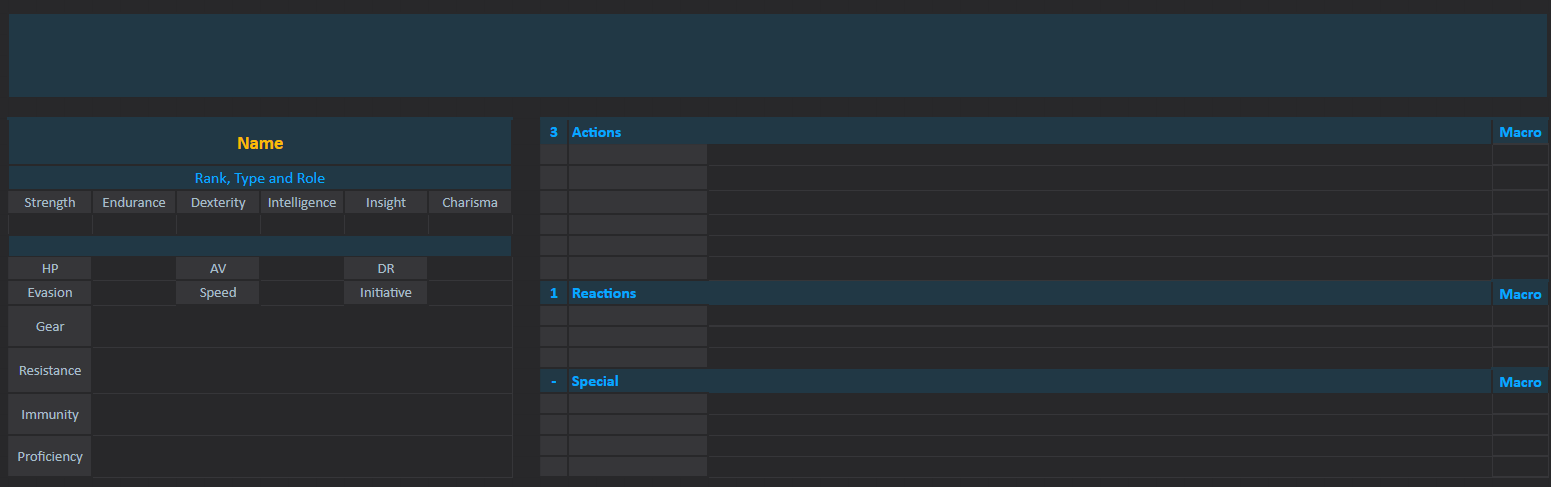
-
This section describes;
The Name of the NPC, whether a Proper Name or a general descriptor.
Their Rank; A creature's rank determines their skill, level of experience and the danger they might pose.
Novice
Regular
Veteran
Elite
Deadly
Their Type - an NPCs types determines their progression, objectives and the sorts of interactions they can have with the player characters.
Humans; Pretty much all known properly sentient life.
Mutants; Humans who possess extensive genetic modification.
Cyborgs/Powered Armor; Humans who have significant mechanical augmentation.
Psions; Humans who can access powerful psionic powers.
Animals; Organic life of not-quite human intelligence.
Mechanical; Drones, Mechs, Vehicles, Turrets.
Aliens; True alien creatures in Blackout are things that defy logic and categorization, from eusocial monstruosities like the Locusts to the quaint superintelligent Grasimi and even pre-blackout entities such as Platforms and Wardens.
Their Role - rather than a mechanical function, roles identify archetypes that can help a GM put together challenging and varied encounters.
Minion; Small, weaker enemies that use numbers to their advantage. Multiple minions usually ‘count’ as a single enemy of their rank.
Tank; Front liners focused on area control and defense.
Brawler; Front liner focused on offense.
Assassin; Fast, deadly and stealthy, but frail.
Specialist; Medics, datacrafters, mechanics, pilots, etc.
Marksman; Long ranged combatants and the sort.
Heavy; Heavy ranged combatants focusing on burst or area of effects.
Leader; Focused on empowering allies and bolstering morale.
Diplomat; Charismatic negotiators who shine out of combat.
-
Attributes are determined just as one would for a simple NPC Stat-block.
-
An NPC's HP is determined by their Endurance Attribute using the formula below;
Minion NPCs - 1xEndurance HP
Novice NPCs - 3x Endurance HP
Regular NPCs - 4x Endurance HP
Veteran NPCs - 6x Endurance HP
Elite NPCs - 10x Endurance HP.
Deadly NPCs - 15x Endurance HP.
-
The number in parenthesis next to an NPCs HP represents the NPC's total Wounds. Most NPCs will have a single Wound but Veteran and Elite NPCs may have an additional Wound and Deadly NPCs may have up to two additional Wounds.
Whenever an NPC is hit by an attack, they may sacrifice a Wound to half the damage inflicted by the attack. NPCs may also lose Wounds to attacks with the Coup de Grace quality or effects that inflict Wounds directly.
If an NPC loses all of their Wounds, they are Out of the Fight. If an NPC loses their last Wound to a Coup de Grace attack, they are instantly killed.
It is recommended that no more than one in three enemies in an Encounter with three enemies or more be a multi-wound NPC.on
-
An NPC's armor value works just as it does on a PC.
On a human, it tends to be determined by the NPC's armor and training.
On a Mechanical Unit, it tends to be determined by the Mods installed in the unit.
On Aliens and Animals, AV tends to be determined by Role and Rank. Higher AV usually means lower Evasion - the four numbers below correspond to suggested maximum AV limits for no-armor/light armor/medium armor and heavy armor equivalents for Aliens and Animals. (Shields/Deflectors and similar special abilities may increase this if available)
Novice; 4/4/7/10
Regular; 4/6/9/12 AV
Veteran; 6/9/11/14 AV
Elite; 7/10/12/16 AV
Deadly; 10/12/14/18 AV
-
Damage Resistance works on NPCs just as it does on Player Characters- however, it is all considered Natural DR which comes back on a full rest.
Human NPCs' DR is determined by their armor, gear and training.
Mechanical NPCs DR is determined by armor, gear and mods.
Animal and Alien DR is determined by their Endurance, usually being equal to their Endurance Attribute. This can be up to doubled for Veteran and Elite NPCs and tripled for Deadly NPCs.
Minion NPCs have half the DR they would normally have.
-
An NPCs passive Evasion, kept separate from their Dexterity Attribute. This represents how hard the NPC is to hit with an attack and is usually determined by Rank and armor type. Below are suggested value for no armor/light armor/medium armor/heavy armor or its equivalent.
Novice; Evasion 3/3/2/1
Regular; Evasion 4/4/3/2
Veteran; Evasion 5/4/3/2
Elite; Evasion 5/5/3/2
Deadly; Evasion 5/5/4/3
Do keep in mind these are only recommendations- particularly fast and fragile enemies, for example, may have higher passive evasion than what is recommended.
-
A creatures' walking/running speed - or the amount of feet a creature moves when taking a move/run action.
Most humans have a walking speed of 30 feet and running speed of 60 feet. NPCs wearing no armor will have +10ft running speed. NPCs wearing Medium Armor will have -5ft running speed and NPCs wearing Heavy Armor will have -10ft running speed.
Mechanical Unit's speed depend on their frame and mods.
Alien and Animal speed varies considerably, but seldom goes beneath 10 feet walking or above 80 feet running speed. Additionally, special forms of locomotion such as flying are usually considered Running.
-
Initiative determines how quickly an NPC goes each round of combat.
Unlike PCs, NPCs have a fixed initiative in combat.
NPCs will always lose initiative ties with PCs.
Enemy NPCs and Allied NPCs will act intermittently if they tie for initiative.
NPCs will always 'roll' for their Max AP.
NPCs initiative is determined as such; 6 + 1(for every 3 Endurance over 3), +1 (for every 3 AV over 6).
-
Conventional NPCs all have 3 action points.
-
You can note any weapons, armor, accessories or expendable items an NPC has here- this can be used to mark down the expenditure of those items, to keep track of mods and the sort, or to allow the party to take those items if they defeat or disarm an NPC.
Humans typically carry gear in the same way as PCs do.
Mechanical Units may hold or have mounted weapons.
Aliens and Animals typically carry no gear and rely on special abilities instead.
-
You can note any Shockproof, Fireproof, Coldproof, Chemproof, Stealth or Shield Projector qualities an NPC might have here- as well as immunity to certain conditions.
For Humans, many of these qualities will come from Gear, training or gene-mods.
For Mechanical Units, they will come from their type, gear or mods.
For Aliens and Animals, these qualities may be innate or come from special abilities.
-
You can note if an NPC is proficient at anything in particular here; for example piloting, hacking, medicine or particular combat maneuvers.
Most, but not all, Animals do not have nor require Proficiencies.
-
The types of actions available to the NPC. Most NPCs can undertake any available action in the Actions section of the Combat Rules- but these can be specific actions to a particular NPC such as Weapon Attacks, Item use or special innate abilities in the case of Gene-Modded Humans, Mechanical Units, Animals or Aliens.
Any advantages included in an Action should be baked into the dice-roll required for it for simplicity. For attacks, the correct notation is;
(AP Cost) Name of the Attack (Attack: (X)D / Damage: (X)D / Clip: X-X / Range: X-Xft. / Qualities)
In the case of a Melee attack, the Damage is (Strength)D - to a maximum of 7 for humans- plus any modifiers granted from training or gear.
In the case of abilities that consume a resource, such as Energy, Tech Points, Stamina or Psionic Focus - the NPC will instead be able to use each ability between 1 and 3 times per day. Higher cost abilities will have fewer per-day uses.
-
You can note any Special Reactions available to the NPC here. NPCs are also assumed to have access to any of the standard reactions from the Action list in the Combat Rules.
-
NPCs do not have or expend Stamina. Instead, whenever they would be able to use a maneuver or ability that allows them to expend Stamina for additional effects, they cannot expend more than 3.
-
You may note any special rules an NPC may have here, be it through a scenario, ability, gear, Gene Mod, training or any innate special abilities from their Type.
Boss NPCs
Sometimes, GMs will want a particularly challenging enemy or boss for a significant story beat or high point of their adventure - to convert an regular enemy NPC into a boss, these are some suggested adjustments that can be made to turn an enemy into a Boss.
HP - Duplicate the maximum HP of the enemy you are using as a Boss.
Wounds - Regular and Veteran Bosses gain an additional Wound. Elite and Deadly bosses gain two additional wounds.
DR - Duplicate the maximum DR of the enemy you are using as a Boss.
Action Points - Regular and Veteran Bosses have 1 additional Action Point. Elite and Deadly Bosses have 2 additional Action points.
Reactions - Regular and Veteran Bosses have 1 additional Reaction. Elite and Deadly Bosses have 2 additional Reactions.
NPC Scaling
Outside of attributes, wounds and HP, Humanoid and Mechanical NPCs also become more powerful by obtaining better gear and training. Unlike PCs, however, NPCs don’t have a training section. Instead all of their training, mods and gear is baked into their actions, attributes and special abilities.
When creating NPCs of certain Ranks- particularly Human and Mechanical ones, you can follow the suggestions below as to how to outfit them. However, do make sure to note down exactly what kind of Gear each NPC is being outfitted with in the Gear section of their Stat-block - should the PCs disarm an NPC, be given gear as a gift, steal it or take it after defeating them.
Human NPC Scaling
Novice;
1-2 Unmodded Weapons.
0-1 Unmodded Armor
0-1 Accessories
2 Level 2 Training Options.
4 Level 1 Training Options.
3 Gene Mod Points (if mutant)
2 Psionic Talents (if Psion)
3 Implant Bulk (if cyborg)
Regular;
1-2 Partially Modded Weapons
1 Partially Modded Armor or Envirosuit
0-1 Accessories
0-1 Expendable Items/Tool.
2 Level 3 Training Options.
4 Level 2 Training Options.
4 Gene Mod Points (if mutant)
3 Psionic Talents (if Psion)
5 Implant Bulk (if cyborg)
Veteran;
0-1 Rare Partially Modded Item
1-2 Fully Modded Weapons
1 Fully Modded Armor or Envirosuit
0-1 Accessories
1-2 Expendable Items/Tool
2 Level 4 Training Options.
4 Level 3 Training Options.
5 Gene Mod Points (if mutant)
3 Psionic Talents and 1 Psionic Power (if Psion)
7 Implant Bulk (if cyborg)
Elite;
1 Rare Fully Modded Weapon
1-2 Fully Modded Weapons.
0-1 Rare Fully Modded Armor or Envirosuit
0-1 Fully Modded Armor or Envirosuit.
1-2 Accessories.
1-2 Expendable Items/Tools.
2 Level 5 Training Options.
4 Level 4 Training Options.
7 Gene Mod Points (if mutant)
4 Psionic Talents and 2 Psionic Powers (if Psion)
9 Implant Bulk (if cyborg)
Deadly;
1 Unique Fully Modded Weapon.
1-2 Fully Modded Weapons.
0-1 Unique Fully Modded Armor or Envirosuit.
0-1 Rare Fully Modded Armor or Envirosuit.
2-3 Accessories.
1-3 Expendable Items/Tools.
6 level 5 training options.
10 Gene Mod Points (if mutant)
4 Psionic Talents, 2 Psionic Powers and 1 Psionic Mastery (if Psion)
12 Implant Bulk (if cyborg)
Mechanical NPC Scaling
Novice;
1-2 Unmodded Weapons.
50% of Mod Slots filled.
Regular;
1-2 Partially Modded Weapons
100% of Mod Slots Filled
Veteran;
0-1 Rare Partially Modded Item
1-2 Fully Modded Weapons
1 Expendable Item/Tool
150% of Mod Slots Filled
Elite;
1 Rare Fully Modded Weapon
1-2 Fully Modded Weapons.
0-1 Rare Fully Modded Armor or Envirosuit
1-2 Expendable Items/Tools.
200% of Mod Slots Filled
Deadly;
1 Unique Fully Modded Weapon.
1-2 Fully Modded Weapons.
1-3 Expendable Items/Tools.
300% of Mod Slots Filled.
Aliens and Animals instead scale by gaining improved versions of their innate abilities or by being granted new special abilities..

Below you can see a few examples of fully filled complex stat-blocks for Blackout NPCs at different levels of play.

Crafting an Encounter
There are no hard and fast rules to crafting an encounter as the composition of many groups will vary. An encounter that is trivially easy for one group might be a nightmare for another at the same XP level depending on the abilities of the enemies presented, the situation and external factors such as terrain.
The following rules are meant to give an idea on how to build and spend a points budget to design encounters for a Blackout party, but can be further tweaked by GMs to adjust the challenge and tailor the encounter to a specific party composition and situation. (eg. Adding points for particularly combat specialized parties, subtracting points for situations where the terrain is against the party, etc).
The first step is to build an Encounter Point budget, indicating how many points the GM can spend placing enemies on the field. Each adds points to the budget based on the difficulty of the encounter and set a maximum enemy rank (usually reserved for Bosses in a boss encounter) depending on their XP level. Allied NPCs/Followers also add points to the encounter, though these are not adjusted based on difficulty.
| Allied Combatant | Common Encounter | Challenging Encounter | Deadly Encounter | Maximum Enemy Rank |
|---|---|---|---|---|
| 0-500 XP Player Character | +2 pts | +3 pts | +4 pts | Regular |
| 501-1000 XP Player Character | +4 pts | +6 pts | +8 pts | Veteran |
| 1001-1500 XP Player Character | +6 pts | +9 pts | +12 pts | Veteran |
| 1501-2000 XP Player Character | +8 pts | +12 pts | +16 pts | Elite |
| 2001-2500 XP Player Character | +10 pts | +15 pts | +20 pts | Deadly |
| Minion NPC | +1 pts | |||
| Novice NPC | +2 pts | |||
| Regular NPC | +4 pts | |||
| Veteran NPC | +8 pts | |||
| Elite NPC | +16 pts |
Spending Encounter Points
Once an encounter budget has been set, the GM can spend those encounter points to add enemies to the encounter. Additionally, Hazards, Dangers and Terrains features (upcoming) can also be purchased with encounter points for the encounter. For encounters where it would make sense, it is recommended the GM spends an additional 30% of their Encounter Budget as ‘Reinforcements’ which can be slowly added to the encounter if the GM needs to increase the level of challenge.
When purchasing NPCs/Enemies for an encounter, the cost is as follows;
Minion NPCs - 1 point
Novice NPCs - 2 points
Regular NPCs - 4 points
Veteran NPCs - 8 points
Elite NPCs - 16 points
Deadly NPCs - 32 points
‘Boss’ NPCs cost twice as many points as their conventional versions.